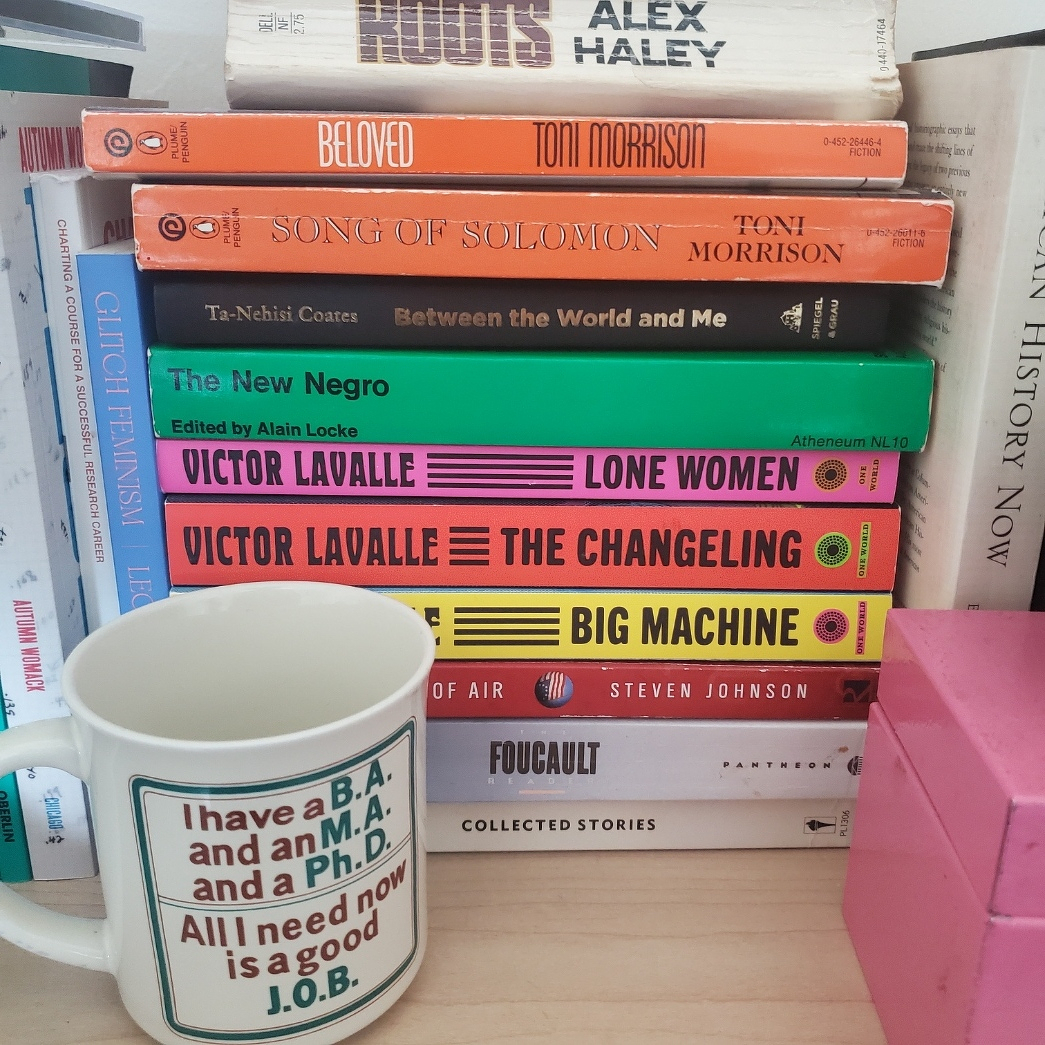
Shelf B1: Black Writing is Surreal History
“I have a B.A. and an M.A., and a Ph.D, and all I need now is a good J.O.B.”—A very wise mug
I saw the mug, and I had to buy it. I wasn’t done finishing the paper, but I knew with this mug, I couldn’t NOT finish the lousy paper that would earn me my master’s degree. I love this mug.
The books behind it, particularly the Victor LaValle ones, are on my mind today. Earlier this month I finished the audiobook copy of The Devil in Silver by LaValle. While listening to the author read his own work, I realized what made me love LaValle’s work so much.
LaValle does two things well: history and surreality.
In my opinion, these two qualities are what I look for in a book, and one I know I can reliably get from Black authors. LaValle, like many of the Black authors depicted on this shelf, adds to the culture in meaningful ways because he cares about the impact of history. Or at least understanding how his characters got there. It starts with the ground beneath their feet and the society that marches all over it. One quirk about LaValle’s characters–protagonist, peripheral or otherwise–is their seemingly meaningless habit of collecting. They make informal archives that, really, wouldn’t matter to anybody, but they matter to them. Mainly newspaper clippings, old books, and phone numbers. As a collector of useless junk, I appreciate this detail. This character quirk of collecting junk speaks to a few threads which make Black literary traditions so rich to me, a wannabe Black writer.
First, it’s the ability to fill in the gaps.
The thing about slavery, and a system that is based on slavery (yet is too cowardly and ashamed to call it quits and give up) is that very few who are made into commodities are privileged to this thing we make, shape, and call—history. Since the introduction of the “peculiar institution,” Black people have kept informal archives of scraps and tatters, and thus relied on stories that turned to myths, legends, and ultimately truths about their history and present conditions. These stories are composites of ancestors who were literally bought and sold. People are numb to that reality for many reasons, but I’ll never get over it, and neither should you. But you know what we can do? Process it. LaValle processes so many different kinds of hurts and loves in his work, but the one I appreciate is the cultural displacement that largely impacts Americans today, and I think it brings us a little closer.
Which is the other most important thing, to imagine.
That is the surreality of his work. I’m not gonna lie, I do not like literary fiction without speculation of some kind. LaValle is always worthwhile to read because he’s always adding some weird shit in there, not just for its own sake, but his surreal plots make me care so much more because he works hard to make the unthinkable thinkable. Blending in real-world history and observations with “what if?” scenarios like: What if trolls were real? Now, having read 4 out of 5 of his novels, my favorite book remains Big Machine. I would call it the perfect secret academic society novel. Dark Academia is a popular subgenre I hate with an unreasonable passion; it is so fucking limp and wet with White innocence it makes me weep. Big Machine, however, is about a middle-aged Black man in New York. How awesome is that? I won’t say more, just read it.
Having been in a secret society of sorts (graduate school), I appreciate these stories for showing me my historical research can be used in other ways, not just some monograph that’s only well-read (or considered well-written) by academic stiffs. I’m trying to follow the things worth doing in my writing. Writing with history in mind and imagining with real-world surreality.
I have a B.A. and an M.A., and all I need now is a good, juicy, observant book.